

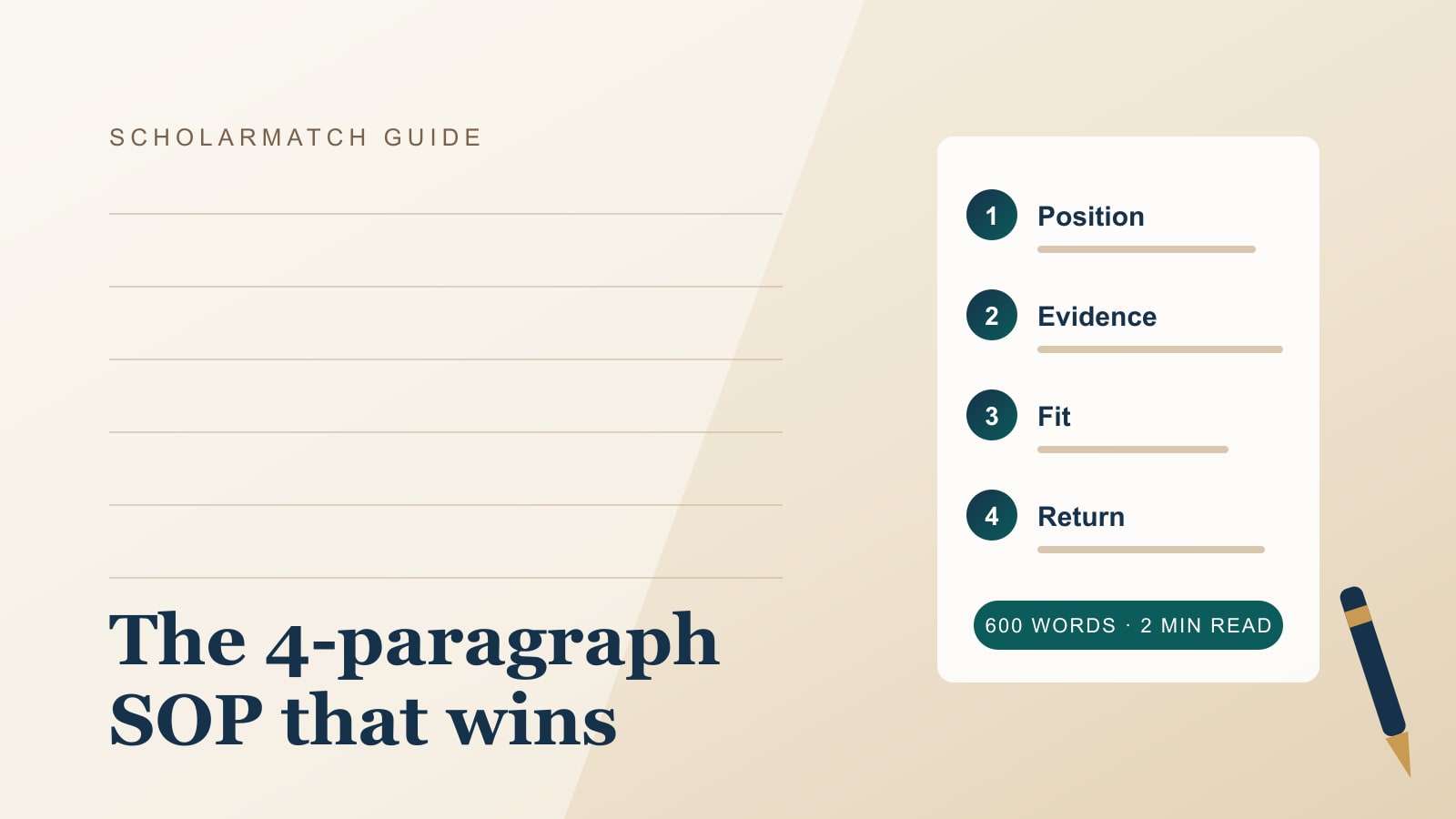
A scholarship panel reads hundreds of statements. Most lose because they answer the wrong question. The winning structure is four paragraphs, roughly 600 words, and each paragraph does one job.
| Paragraph | Word budget | The question it answers | Fatal mistake |
|---|---|---|---|
| 1. Position | 100–120 | Who are you, and what problem are you chasing? | A childhood story that never reaches a research question |
| 2. Evidence | 180–220 | What have you already done that proves you can finish this? | Listing courses instead of outcomes, numbers and decisions |
| 3. Fit | 140–180 | Why this programme, these supervisors, this country? | Flattery that could be pasted into any application |
| 4. Return | 100–140 | What changes when you go back? | Promising to "serve the nation" with no mechanism |
Paragraph 1: Position
Open with the problem, not your biography. Name the gap you want to work on and the question you can answer in two years. Then place yourself in one sentence: your degree, your strongest result, and the experience that made the question urgent.
Paragraph 2: Evidence
This paragraph wins or loses the grant. Give two or three concrete proofs: a thesis, an internship, a dataset, a publication, a teaching role. For each, state what you did, what changed, and what you learned. Use numbers where they are honest. "Built a survey of 240 small businesses and cleaned the dataset in R" beats "have strong research skills".
Paragraph 3: Fit
Name the programme, two modules or labs, and one supervisor whose work connects to your question. Explain what you will use from each. If the programme has a placement or a methods sequence, say how it fills a gap in your training. This proves you read the page, not just the ranking.
Paragraph 4: Return
Funders want a return on the grant. Describe the role, sector or institution you will return to, the specific problem you will work on, and who will benefit. If you plan to stay for a PhD, say how that fits the funder's goals.
Edit for the panel
Cut every sentence that could appear in another applicant's statement. Replace adjectives with evidence. Check that each paragraph answers its question. Then compare your draft with the full guide to winning a funded scholarship and the 2027 application blueprint. Shortlist matching awards in the scholarship explorer and track each deadline from your account.